
Dr. Sujit Dutta

Cost of capital and EVA

Cost of Capital and EVA: Tools for Strategic Financial Decisions

Cost of Capital is the minimum rate of return or profit a company must earn.  It is extremely important to investors and analysts. It’s the cost of obtaining funds, whether through equity or debt and includes the returns expected by shareholders and the interest expenses on debt. Companies look for the optimal mix of financing that provides adequate funding and minimizes the […]

Cost of Capital and EVA: Tools for Strategic Financial Decisions Read More »
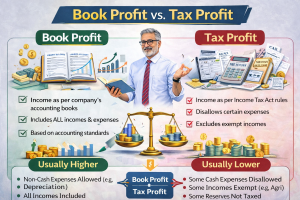
PGBP vs Book Profit

PGBP vs Book Profit – Including Cash Disallowance –Section 40A (3)

Section 43B of the Income Tax Act provides a list of expenses can be claimed as deductions from business income only in the year of actual payment and not in the year when the liability to pay such expenses is incurred. Section 40A (3) disallows tax deductions on expenses above Rs. 10,000 made in cash in a

PGBP vs Book Profit – Including Cash Disallowance –Section 40A (3) Read More »

TDS on Salary and Consequences of Non-Compliance

Good morning, students. This is my second class on TDS, because in our previous session some important questions remained unanswered. Today, we shall clarify them properly. He looked around the class and paused thoughtfully and asked Sweta… what is your question Sweta:Sir, in a company we make payments to contractors, suppliers, transporters and employees. We

TDS on Salary and Consequences of Non-Compliance Read More »

TDS compliance

TDS: An Overview of Understanding Compliance

The bell had just rung, but Mohit and Mrinmoy were still seated, flipping through their notes. The topic for the day was Direct Tax Compliance, and both of them looked slightly unsettled. Mohit leaned towards Mrinmoy and whispered: I understand income tax theory, but in a manufacturing company interview, they won’t ask definitions. They’ll ask

TDS: An Overview of Understanding Compliance Read More »

Stamp duty value vs sale price

Stamp Duty Value vs Actual Sale Price: Which One Governs Capital Gains Tax?

Stam duty value is the value adopted by the Stamp Valuation Authority (SVA) to levy stamp duty on the registration of properties as guidance value to determine the undervaluation of land or buildings, if any, in the sale agreement. Stamp duty valuation is Important for the seller under income tax laws. Under Section 50C, if

Stamp Duty Value vs Actual Sale Price: Which One Governs Capital Gains Tax? Read More »

Regular or Composition? Understanding the Right GST Option

The composition levy is an alternative method of levy of tax designed for small taxpayers. The objective of composition scheme is to bring simplicity and to reduce the compliance cost for the small taxpayers. It allows small businesses to: All persons registered under the Composition Scheme shall file Form GSTR-4 every quarter through the GST

Regular or Composition? Understanding the Right GST Option Read More »

GST returns and reconciliation

Understanding Key GST Returns and the Reconciliation Process

GST reconciliation refers to the act of comparing the GST returns filled by the taxpayer with the financial records of the business. It’s a crucial process for businesses to ensure accuracy and compliance. GSTR-9C is a form for annual GST reconciliation statement filed by applicable taxpayers. Every registered person whose aggregate turnover during a financial year

Understanding Key GST Returns and the Reconciliation Process Read More »

Rebate, marginal relief and surcharge

Rebate, Marginal Relief, Surcharge and Tax Liability in Tax Management

Chandrakant asked: Sir, Tell something about rebate u/s 87A Professor said: Rebate is a tax benefit provided to middle to low-income earners. It is provided only to resident individuals, earning income within 10% slab rate.  Rs. 60,000 rebate is allowed for income within Rs. 12 lakh under the new regime and Rs. 12,500 for income

Rebate, Marginal Relief, Surcharge and Tax Liability in Tax Management Read More »