
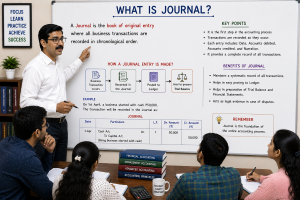
Many students come from non-commerce backgrounds and often find accounting terminology confusing. Terms such as Journal, Ledger, Voucher, Debit, Credit and posting may appear technical at first. However, accounting is essentially a systematic method of recording business transactions.
Before an accountant records a transaction, an important question must be answered:
“What evidence exists that the transaction actually occurred?”
The answer lies in source documents and vouchers. These documents provide the basis for recording transactions in the Journal, which is known as the Book of Original Entry.
Let us understand the concept
Why do we need a Journal?
Professor: Students, suppose a company purchases a laptop for office use. How does the accountant know that the purchase took place?
Student A: There must be a bill or invoice.
Professor: Correct. Accounting records are not based on assumptions. They are supported by documentary evidence.
Only after verifying the supporting document does the accountant record the transaction in the Journal.
Definition
A Journal is the book in which business transactions are recorded for the first time in chronological order by applying the rules of debit and credit.
Therefore, the Journal is often called the: Book of Original Entry
Student B: Sir, what kind of documents are used?
Professor: Good question.
Common source documents include:
| Transaction | Supporting Document |
| Purchase of goods | Supplier Invoice |
| Sale of goods | Sales Invoice |
| Cash received | Receipt Voucher |
| Cash paid | Payment Voucher |
| Bank transaction | Bank Statement |
| Salary payment | Payroll Record |
| Purchase of machinery | Tax Invoice |
| Payment through UPI/NEFT | Bank Advice or Transaction Record |
Without documentary evidence, a transaction should generally not be recorded.
Example 1: Purchase of furniture for cash
Supporting document
Invoice or Bill
Amount: Rs.20,000
Professor: What accounts are affected?
Student C: Furniture increases and Cash decreases.
Professor: Correct.
Journal Entry
Furniture A/c Dr. Rs.20,000
To Cash A/c Rs.20,000
(Being furniture purchased for cash)
Example 2: Goods purchased on credit
Supporting Document
Purchase Invoice received from supplier
Amount: Rs.50,000
Journal Entry
Purchases A/c Dr. Rs.50,000
To Supplier A/c Rs.50,000
(Being goods purchased on credit)
Example 3: Salary paid through bank
Supporting Document
Salary Sheet and Bank Transfer Record
Amount: Rs.50,000
Journal Entry
Salary A/c Dr. Rs.50,000
To Bank A/c Rs. 50,000
(Being salary paid through bank)
What information does a Journal contain?
A typical journal contains:

What Information Does a Journal Contain?
A typical journal contains:
| Date | Particulars | L.F. | Debit (Rs.) | Credit (Rs.) |
Where:
- Date indicates when the transaction occurred.
- Particulars describe the transaction.
- L.F. (Ledger Folio) refers to the ledger page number.
- Debit and Credit columns show the amounts.
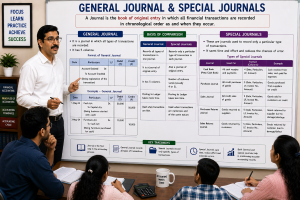
Different types of Journals
Student D: Sir, are all transactions recorded in one journal?
Professor: In small businesses, yes. However, larger organizations often use specialised journals.
1. General Journal
Used for:
- Opening entries
- Adjustment entries
- Rectification entries
- Closing entries
General Journal: Examples
| Used For | Example | Journal Entry |
| Opening entries | Business starts the year with Cash Rs.1,00,000 and Furniture Rs.50,000. | Cash A/c Dr. Rs.1,00,000 Furniture A/c Dr. Rs.50,000 To Capital A/c Rs. 1,50,000 |
| Adjustment entries | Salary for March Rs.5,000 is outstanding at year-end | Salary A/c Dr. Rs.5,000 To Outstanding Salary A/c Rs.5,000 |
| Rectification entries | Office rent Rs.2,000 wrongly debited to Salary Account | Rent A/c Dr. Rs.2,000 To Salary A/c Rs.2,000 |
| Closing entries | Transfer salary expense of Rs.50,000 to Profit & Loss Account at year-end | Profit & Loss A/c Dr. Rs.50,000 To Salary A/c Rs.50,000 |
Student: Sir, why are these entries recorded in the General Journal and not in the Purchase Journal or Sales Journal?
Professor: Because these transactions do not occur regularly like purchases, sales or cash receipts/payments. They are special accounting entries generally passed at the beginning, during review, correction or closing of an accounting period.
Quick Understanding
| Type of Entry | Purpose |
| Opening entry | Brings forward assets, liabilities and capital at the beginning of the accounting period |
| Adjustment entry | Ensures income and expenses are recorded in the correct accounting period |
| Rectification entry | Corrects accounting errors |
| Closing entry | Transfers income and expense balances to Profit & Loss Account and prepares books for the next period |
Special Journal
2. Purchase Journal
Records credit purchases of goods.
3. Sales Journal
Records credit sales of goods.
4. Purchase Returns Journal
Records goods returned to suppliers.
5. Sales Returns Journal
Records goods returned by customers.
6. Cash Book
Records cash and bank transactions and often functions as both a journal and a ledger.
Understanding Special Journals
| Journal | Purpose | Example transaction | Journal entry | Are cash transactions recorded here? |
| Purchase Journal | Records credit purchases of goods meant for resale | Purchased goods on credit from ABC Traders Rs.50,000 | Purchases A/c Dr. Rs.50,000 To ABC Traders A/c Rs.50,000 | No. Cash purchases are recorded in the Cash Book. |
| Sales Journal | Records credit sales of goods | Sold goods on credit to Mr. Raj Rs.30,000 | Raj A/c Dr. Rs.30,000 To Sales A/c Rs.30,000 | No. Cash sales are recorded in the Cash Book. |
| Purchase Returns Journal (Returns Outward Book) | Records return of goods previously purchased on credit | Returned goods worth Rs.5,000 to ABC Traders | ABC Traders A/c Dr. Rs.5,000 To Purchase Returns A/c Rs.5,000 | No. Cash purchase returns are recorded through the Cash Book. |
| Sales Returns Journal (Returns Inward Book) | Records return of goods previously sold on credit | Customer returned goods worth Rs.2,000 | Sales Returns A/c Dr. Rs.2,000 To Customer A/c Rs.2,000 | No. Refunds relating to cash sales are recorded through the Cash Book. |
Why is Journal important?
Professor: Imagine a business performing hundreds of transactions every month.
Without a Journal:
- Transactions may be omitted.
- Transactions may be duplicated.
- The sequence of events may be lost.
The Journal ensures that every transaction is recorded systematically and chronologically.
What happens after the Journal?
Student A: Once the Journal is prepared, what happens next?
Professor: The entries are transferred to the Ledger.
The process is called: Posting
Thus:
| Source Documents ↓ Journal ↓ Ledger ↓ Trial Balance ↓ Financial Statements |

Fundamental Accounting Concepts
| Source document | Typical business event | Accounting impact |
| Purchase Invoice | Purchase of goods/assets | Increase in assets or expenses |
| Sales Invoice | Sale of goods/services | Increase in income |
| Receipt | Receipt of cash or cheque | Increase in cash/bank |
| Payment Voucher | Payment made | Decrease in cash/bank |
| Bank Statement | Bank transaction | Increase or decrease in bank balance |
| Debit Note | Purchase return | Reduction in liability |
| Credit Note | Sales return | Reduction in receivable or sales |
For revision purpose it helps a lot to me.
nice to hear! keep foloowing..
This was much needed for me. Thanks a lot sir.