
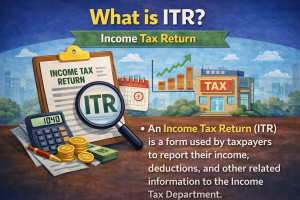
Filing the correct Income Tax Return (ITR) form is a crucial responsibility for taxpayers. However, many people—especially students and first-time filers—often get confused about which ITR form applies to their specific situation. This blog aims to simplify that confusion by providing a clear guide on ITR form numbers and their practical applicability, helping students and taxpayers understand which form they should use.
ITR-1 (Sahaj)
| Applicable To | Individual (Resident) |
| Type of Income Allowed | Salary, PensionOne House Property (the person should not own any property outside India. Other Income from Other Sources (excluding activities like horse racing, gambling, lotteries, and more). The taxpayer should not have foreign income. Total income below Rs. 50 lakhs |
| Business Income | Not allowed |
| Capital Gains | LTCG u/s 112A not exceeding Rs.1.25 lakh with no brought forward or carry forward of losses. |
| Typical Example | Form ITR-1, also known as ITR-1 (SAHAJ) is one of the ITR forms that is best suited for salaried people and people having income from other sources from interest on Deposits, dividend. |
| Not Eligible | Agricultural income is more than Rs 5,000director in a company.Incurred losses under Income from Other Sources.The taxpayer should not have foreign income. |
ITR-2
| Applicable To | Individual / HUF [Taxpayers not eligible to File ITR-1 (SAHAJ)], Non-Resident |
| Type of Income Allowed | Salary/pension. More than one house property. Other Sources (including horse racing, card games, lotteries, gambling, etc.). |
| Business Income | Not Allowed |
| Capital Gains | All Capital Gains Income and Losses are allowed |
| Typical Example | Taxable income exceeding Rs 50 lakhs In case the individual has property or assets abroad. Taxpayers who have foreign income or income from outside India |
| Not Eligible | Taxpayers (Individual or HUF) having income from Business or profession are not eligible to file ITR. Companies, Firms, and trusts are not eligible to file ITR 2 or ITR 1. |
ITR-3
| Applicable To | Individual / HUF |
| Type of Income Allowed | . All the income can be included like business income, capital gains, casual income, salary income, etc., |
| Business Income | Allowed. Books of accounts are required to be maintained if threshold limit crossed u/s 44AA. |
| Capital Gains | Allowed |
| Typical Example | Businesses other than companies and firms. |
| Remarks | Audit requirement is mandatory if the income or turnober crosses limits specified u/s 44 AB. |
| Not Eligible | Individuals and HUFs without income from a business, profession, or partnership firm are not eligible to file the ITR-3 Form. Local authorities, bodies of individuals and associations of persons |
ITR-4 (SUGAM)
| Applicable To | Resident Individuals, HUFs and partnership firms with business or professional income, and opting for presumptive taxation under Section 44AD, Section 44ADA, or Section 44AE. |
| Type of Income Allowed | Salary, PensionOne House Property (the person should not own any property outside India. Business or professional income is computed on a presumptive basis under Section 44AD, 44ADA or 44AEOther Income from Other Sources (excluding activities like horse racing, gambling, lotteries, and more). The taxpayer should not have foreign income. Total income below Rs. 50 lakhs |
| Business Income | Small taxpayers whose annual turnover or gross receipts are relatively low. |
| Capital Gains | Long-term capital gains u/s 112 A up to Rs. 1.25 lakhs (having no brought-forward or carry-forward capital loss) |
| Typical Example | |
| Not Eligible | Foreign Income and Assets Claiming relief u/s 90 or DTAAs Individuals have held unlisted equity shares at any time during the yearA person is a director in any companyTaxpayers whose income tax is deferred on ESOP |
ITR-5
| Applicable To | Firm, LLP, AOP, BOI, AJP (Artificial Juridical Person), Estate of deceased, Estate of insolvent, Business trust and investment fund, Cooperative Society, Society registered under Societies Registration Act, 1860 or under any other law of any State, Trust other than Trusts eligible to file Form ITR-7 , |
| Type of Income Allowed | Business / Professional Income, Income from House Property, Capital Gains (STCG & LTCG), Income from Other Sources (interest, commission, etc.) |
| Business Income | Allowed |
| Capital Gains | Allowed |
| Typical Example | Chartered Accountants Firms, Tech Solutions LLP, M/s Sharma Traders (Partnership) |
| Not Eligible | Individual and Companies |
ITR-6
| Applicable To | Domestic Companies, Foreign Companies, all Partnership Firms, and company that has income from business or profession must file ITR 6. |
| Type of Income Allowed | Business / Professional Income, Income from House Property, Capital Gains (STCG & LTCG), Income from Other Sources (interest, commission, etc.) |
| Business Income | Allowed |
| Capital Gains | Allowed |
| Typical Example | ABC Pvt. Ltd., XYZ Ltd., FinTech Start Pvt. Ltd. |
| Not Eligible | Companies that claim exemption under: Section 11 of Income Tax Act Section 12 of Income Tax Act These are typically: Charitable trusts Religious institutions Section 8 companies (non-profit) |
ITR-7
| Applicable To | ITR-7 is a form for entities that are required to furnish a return of income under Section 139(4A)- Income of Charitable and Religious Trusts, or 139(4B)- Political Parties or 139(4C)- Scientific research institutions or 139(4D)- University, college, or other institution. of the Income Tax Act. |
| Type of Income Allowed | It shows details of income from donations, investments, and business activities (if any), Income from Other Sources, Capital Gains, Income from trust property. |
| Business Income | Business activity is incidental to their main objectives and separate books of accounts are maintained. |
| Capital Gains | Allowed |
| Typical Example | Charitable trusts (education, healthcare, relief work) Religious trusts Non-profit NGOs / societies registered for charitable purposes Section 8 companies (non-profit companies under Companies Act) Political parties (registered with Election Commission) Universities, colleges, and educational institutions claiming exemption |
| Not Eligible | Individuals (normal taxpayers), Partnership firms / LLPs (not claiming exemption), Companies (profit-making), Businesses with no charitable purpose. |

This blog is intended for academic purposes only and aims to discuss the concepts related to Income Tax Return (ITR) forms. It does not constitute professional, legal, or financial advice, nor should it be considered a recommendation for any specific action.