
Translation Exposure: The translation exposure is also called accounting exposure or
balance sheet exposure. Translation risk is based on assets, equities, liabilities on the Balance Sheet in foreign currency to domestic currency. Strictly speaking. There is no actual gain or loss seen here.
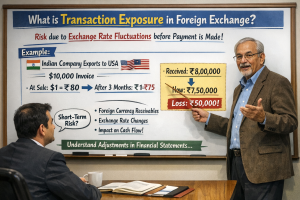
Transaction Exposure: A firm may have some contractually fixed payments and receipts in
foreign currency, such as, import payables, export receivables, interest payable on foreign
currency loans etc. All such items are to be settled in a foreign currency. Unexpected
fluctuation in exchange rate will have favourable or adverse impact on its cash flows. Such
exposures are termed as transactions exposures.
Therefore,
- Transaction Exposure → Risk from a specific foreign currency contract.
- Translation Exposure → Risk from accounting conversion of financial statements.
This imaginary case study will help students understand the concepts of transaction risk and translation risk in foreign exchange operations and their impact on a company’s financial statements. The example illustrates how fluctuations in exchange rates can affect contractual foreign currency transactions as well as the accounting translation of foreign assets and liabilities in financial reporting.

This case study uses the name of a company purely for academic understanding of the concept. The case is imaginary, and the company name is used only to illustrate and explain foreign exchange risk exposures.
International Operations of Tata Motors
Assume the company has the following international transactions:
- Export receivable from USA: $1,000,000
- Exchange rate at sale: Rs.80 / $
- Exchange rate at payment: Rs. 75 / $
Also assume its UK subsidiary Jaguar Land Rover has net assets of £500 million.
Income Statement Impact (Transaction Exposure)
At the time of sale
Expected revenue:1,000,000×80=Rs. 80,000,000
When Payment is Received
Actual revenue:1,000,000×75=Rs. 75,000,000
Forex Loss: Rs.5,000,000
Income Statement
| Particulars | Amount (Rs.) |
| Export Sales | 80,000,000 |
| Less: Forex Loss | (5,000,000) |
| Net Export Revenue | 75,000,000 |
This is Transaction Exposure.
Balance Sheet Impact (Translation Exposure)
UK subsidiary net assets:
£500 million
Exchange rate changes:
| Year | GBP/INR |
| Year 1 | Rs.100 |
| Year 2 | Rs.90 |
Value in Consolidated Balance Sheet
| Year | Value in INR |
| Year 1 | Rs.50,000 million |
| Year 2 | Rs.45,000 million |
Translation loss: Rs,5,000 million
Balance Sheet Impact
| Assets | Amount (Rs. million) |
| Foreign Subsidiary Net Assets | 45,000 |
| Equity | Amount |
| Translation Reserve Loss | (5,000) |
This is Translation Exposure.
Cash Flow Impact (Transaction Exposure)
Cash actually received from export:
| Particulars | Amount |
| Expected inflow | Rs.80,000,000 |
| Actual inflow | Rs.75,000,000 |
| Forex loss in cash flow | Rs.5,000,000 |
Cash Flow Statement (Operating Section)
| Particulars | Amount |
| Cash received from exports | Rs.75,000,000 |
This shows how forex volatility affects actual cash inflows.

Now there is a question: Why Translation Loss is Adjusted in Equity (Translation Reserve)?
Answer: When a multinational company like Tata Motors consolidates the financial statements of its foreign subsidiary Jaguar Land Rover, the assets and liabilities of the subsidiary must be converted from foreign currency into the parent company’s reporting currency.
If the exchange rate changes, the value of those assets and liabilities changes when expressed in INR.
However, this change is only due to accounting conversion, not due to an actual transaction.
No real cash flow occurs
In translation exposure:
- The company has not sold the asset
- The company has not received or paid foreign currency
Therefore:
- There is no realized gain or loss
- It is only a book adjustment
Because of this, accounting standards require that such changes should not affect current profit.
Why translation gain or loss is not adjusted in Operating Profit
If translation gains or losses were recorded in the Income Statement, it would:
- Artificially inflate or reduce profit
- Make operational performance misleading
Example:
A large currency fluctuation could show huge accounting losses even when the company’s business is doing well.
Therefore, the adjustment is made directly in equity.
The translation difference is recorded in a separate component of shareholders’ equity, commonly called:
- Foreign Currency Translation Reserve (FCTR)
or - Translation Adjustment Reserve
Balance Sheet Illustration
| Equity Section | Amount |
| Share Capital | Rs. X |
| Retained Earnings | Rs. Y |
| Foreign Currency Translation Reserve | (Rs.5,000 million) |
| Total Equity | Adjusted |
The translation reserve affects profit only when the foreign subsidiary is disposed of or sold.
At that time:
- The accumulated translation reserve is transferred to the Profit & Loss Account.

Treatment of Translation Exposure under Ind AS 21
When an Indian parent company consolidates the financial statements of a foreign operation, the assets and liabilities of that foreign entity must be translated into the presentation currency.
Exchange rate changes create translation differences.
According to Ind AS 21 – The Effects of Changes in Foreign Exchange Rates:
Exchange differences arising on translation of foreign operations are recognized in Other Comprehensive Income (OCI) and accumulated in Equity under Foreign Currency Translation Reserve (FCTR).
*This example is provided solely for academic understanding of the concept and is not intended for any professional, financial, or advisory purpose. It is meant only to illustrate the theoretical aspects of foreign exchange risk and accounting treatment