

A firm dealing with foreign exchange may be exposed to foreign currency exposures. The
exposure is the result of possession of assets and liabilities and transactions denominated ‘in
foreign currency. When exchange rate fluctuates, assets, liabilities, revenues, expenses that have
been expressed in foreign currency will result in either foreign exchange gain or loss. A firm
dealing with foreign exchange may be exposed to the following types of risks:
- Transaction Exposure
- Translation Exposure
- Operating Exposure
Transaction Exposure: A firm may have some contractually fixed payments and receipts in
foreign currency, such as, import payables, export receivables, interest payable on foreign
currency loans etc. All such items are to be settled in a foreign currency. Unexpected
fluctuation in exchange rate will have favourable or adverse impact on its cash flows. Such
exposures are termed as transactions exposures.
Translation Exposure: The translation exposure is also called accounting exposure or
balance sheet exposure. Translation risk is based on assets, equities, liabilities on the Balance Sheet in foreign currency to domestic currency.
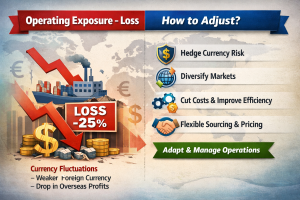
Operating Exposure: Operating exposure occurs when some external development in the global market changes the company’s expected revenues or costs.
- Macroeconomic events affecting currency values
- Some phenomenon somewhere happened that takes the market in loss making situation
Therefore,
- Transaction Exposure → Risk from a specific foreign currency contract.
- Translation Exposure → Risk from accounting conversion of financial statements.
- Operating Exposure → Risk from changes in the economic environment affecting the firm’s future business.
This imaginary case study is designed to help students understand the concept of operating exposure in foreign exchange risk and how such exposure can influence a company’s financial performance. Through this example, we will observe how changes in external economic conditions and exchange rates may affect a firm’s revenues, costs, and ultimately its financial statements
This case study uses the name of a company purely for academic understanding of the concept. The case is imaginary, and the company name is used only to illustrate and explain foreign exchange risk exposures.
Operating Exposure and Financial Statement Impact (Ind AS)
Suppose an Indian automobile company Tata Motors exports cars to the USA.
Expected export transaction:
- Expected export sales: $10 million
- Expected exchange rate: $1 = Rs.80
Expected revenue in India:
10,000,000×80= Rs. 800,000,000
So, the company plans its production, cost structure and profit based on this expected revenue.
Note: If the company’s functional currency is INR, it means: All transactions must ultimately be recorded and reported in INR, even if they are conducted in foreign currency.
Initial Recognition
- As per Ind AS 21 – The Effects of Changes in Foreign Exchange Rates.
- Foreign currency transactions are recorded at the spot rate on the transaction date.
External Event (Operating Exposure Arises)
Due to global economic changes, the Indian Rupee appreciates.
New exchange rate: Rs.1= Rs. 72
Now the export revenue becomes: 10,000,000×72= Rs. 720,000,000
Loss in expected revenue:
Rs. 800,000,000-Rs. 720,000,000=Rs. 80,000,000
This reduction happens not because of a specific forex contract, but because of market forces affecting the company’s competitiveness and revenue.
Note: Recognition of Loss
Difference: Rs. 80,000,000 (loss)
This is recognized in Profit & Loss.
This is Operating Exposure.
Effect on Financial Statements
Unlike translation exposure, operating exposure directly affects the income statement because it impacts real business performance.
Note:
- This is not conversion of financial statements
- This is a real transaction (export sale)
Income Statement
| Particulars | Expected (Rs.) | After Currency Change (Rs.) |
| Export Revenue | 800,000,000 | 720,000,000 |
| Operating Cost | 600,000,000 | 600,000,000 |
| Operating Profit | 200,000,000 | 120,000,000 |
Reduction in profit: Rs.
Thus, the impact appears in operating profit.
Balance Sheet Impact
Lower profit results in:
| Equity Section | Before | After |
| Share Capital | same | same |
| Retained Earnings | higher | reduced |
| Total Equity | reduced | reduced |
So, operating exposure reduces retained earnings indirectly.
Cash Flow Statement Impact
Operating cash inflow declines.
| Cash Flow from Operations |
| Expected: Rs.800,000,000 |
| Actual: Rs.720,000,000 |
Thus, cash flow from operations decreases.
Accounting Standards reference: Under Ind AS 21 – The Effects of Changes in Foreign Exchange Rates.
- Operating exposure is not an accounting adjustment
- It reflects real business performance
- Therefore, its impact is recorded normally through revenue and operating profit
Unlike translation exposure, it is not recorded in OCI or translation reserve.

*This example is provided solely for academic understanding of the concept and is not intended for any professional, financial, or advisory purpose. It is meant only to illustrate the theoretical aspects of foreign exchange risk and accounting treatment.