

International capital markets refer to financial markets that facilitate the buying and selling of financial instruments such as equities, bonds, and derivatives across national borders. There are two main ways that someone accesses the capital markets—either as debt or equity. Companies may raise debt (ECB, Eurobond), equity (ADR, GDR), or hybrid securities (FCCB) depending on cost of capital, investor base, and strategic financial planning.
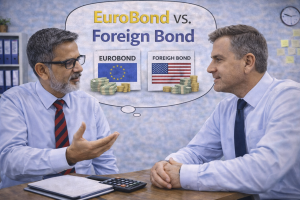
This discussion focuses on international debt instruments and explains how companies can access global sources of finance prudently to meet their funding requirements.
Let’s take an example
Suppose ABC Ltd. (India) needs $100 million.
It has several options:
| Instrument | What ABC Ltd. does |
| ECB | Borrow $100 million from international banks |
| Eurobond | Issue $100 million bonds in London |
| FCCB | Issue bonds that investors may convert into shares later |
| ADR | Allow US investors to buy its shares through US markets |
| GDR | Allow global investors to buy its shares in international exchanges |
Before discussing the international debt instruments in detail, it is important to recognize that terms such as ECB, FCCB, Foreign bond and Eurobond frequently appear in international finance and corporate funding discussions. Although they are all related to raising funds from international markets, they differ significantly in their nature, structure, and purpose.
Some of these instruments represent debt, some represent equity, while others combine features of both. For students of international finance, it is therefore essential to clearly understand how these instruments operate and why companies choose one over another when raising funds globally.
In the following section, we will examine each instrument one by one with simple examples, and then highlight the key differences through a comparative table so that the distinctions among them become clear and easy to remember.
International Debt Market: Concepts and Instruments
The International Debt Market refers to the global market where governments, corporations, and financial institutions borrow funds in foreign currencies from international investors.
Companies access this market to:
- Raise large amounts of capital
- Obtain funds at lower interest rates
- Diversify sources of finance
- Finance international expansion
Major instruments in this market include:
- External Commercial Borrowings (ECB)
- Eurobonds
- Foreign Bonds
- Foreign Currency Convertible Bonds (FCCB)
- Global Bonds
- Syndicated Loans
External Commercial Borrowings (ECB)
ECB refers to loans raised by companies from foreign lenders in foreign currency.
Borrowers may include:
- Indian companies
- Public sector undertakings
- Financial institutions
Sources of ECB:
- International banks
- Export credit agencies
- Foreign equity holders
- International capital markets
Example
An Indian company borrows $50 million from a bank in London.
Purpose:
- Import of machinery
- Infrastructure projects
- Capital expansion
ECB is regulated in India by Reserve Bank of India guidelines.
Eurobond: A Eurobond is a debt instrument that’s denominated in a currency other than the home currency of a country or market in which it is issued.
- An expel of Eurobond is a bond issued by a Russian Corporation in European Market that pays interest and principal in US dollars.
- A US dollar bond issued in London by an Indian company.
- An Indian company issues $100 million bonds in London
These bonds are called Eurobonds.
Key features:
- Sold in international markets
- Usually issued through a syndicate of international banks
- Less regulatory restrictions
Foreign Bond: A foreign bond is a bond issued in domestic market by a foreign entity in the domestic market’s currency as a means of raising capital.
An Indian company issues yen bonds in Japan.
These bonds must follow Japanese financial regulations.
Difference: Eurobond vs Foreign Bond
| Basis | Eurobond | Foreign Bond |
| Currency | Foreign currency | Currency of the country where issued |
| Market | International market | Domestic market of another country |
| Regulation | Less regulated | Subject to domestic regulations |
| Investors | Global investors | Local investors of that country |
| Example | USD bond issued in London | Yen bond issued in Japan |
Foreign Currency Convertible Bonds (FCCB)
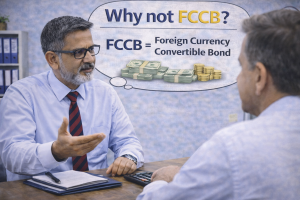
FCCB is a bond issued in foreign currency that can later be converted into equity shares of the issuing company.
Features:
- Fixed interest payment
- Option to convert into shares
- Attractive for investors expecting share price growth
Example
An Indian company issues:
$10 million FCCB with conversion option.
Investor can choose:
- Receive interest and principal, or
- Convert bonds into company shares.
Global Bonds
A Global Bond is issued simultaneously in multiple international markets.
Example:
A company issues bonds in:
- US market
- European market
- Asian market
This allows companies to reach a wider investor base.
Syndicated Loans
A syndicated loan is a large loan provided by a group of international banks.
Used when funding requirement is very large.
Example:
A project requiring $500 million may be financed by:
- 5 or 6 international banks jointly.
Summary Table: International Debt Instruments
| Instrument | Currency | Market | Key Feature |
| ECB | Foreign currency | International lenders | Loan from foreign sources |
| Eurobond | Foreign currency | International market | Issued outside country of currency |
| Foreign Bond | Domestic currency of issuing country | Domestic market of foreign country | Regulated locally |
| FCCB | Foreign currency | International investors | Convertible into equity |
| Global Bond | Multiple currencies | Multiple markets | Issued globally |
| Syndicated Loan | Usually, foreign currency | International banks | Large loan shared by banks |