
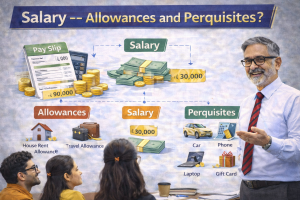
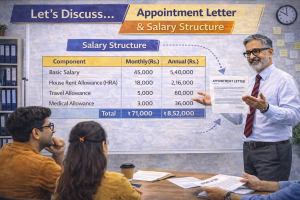
When you receive your first appointment letter, you will often find several components listed in your salary structure—basic pay, allowances, perquisites, reimbursements, and other benefits. For many fresh professionals, the terms “allowances” and “perquisites” can be confusing.
It is important not to overlook these terms. Understanding them properly helps you interpret your salary structure, estimate your take-home salary, and understand the tax implications associated with each component.
Before accepting or evaluating an offer, one should carefully review the appointment letter and identify which components are allowances and which are perquisites, as their tax treatment can differ significantly.
Let’s explore these concepts with examples and tax rules so that students and young professionals can clearly understand how these components affect their salary taxation and net income.

Professor writes on the board:
Allowances ≠ Perquisites
Samuel raises his hand: Sir, both are benefits given by employer. Then why are they treated differently?
Professor smile: good. Today we will remove this confusion permanently.
Allowance is: A fixed monetary payment given by employer to employee to meet certain expenses. It is paid in cash as part of salary.
Let’s see different types of allowances
Fully Taxable Allowances
| Allowance | Tax Treatment | Relevant Provision |
| Dearness Allowance (DA) | Fully Taxable | Sec 17(1) |
| City Compensatory Allowance | Fully Taxable | Salary Income |
| Overtime Allowance | Fully taxable | Salary Income |
| Special Allowance (general) | Fully taxable | Sec 17(1) |
| Tiffin / Lunch Allowance (cash) | Fully taxable | Salary income |
| Fixed Medical Allowance (cash) | Fully taxable | Salary income |
| Servant Allowance | Fully taxable | Salary income |
Partially exempt allowances (Subject to conditions)
| Allowance | Exemption Provision | Tax Rule |
| House Rent Allowance (HRA) | Sec 10(13A) | Least of 3 conditions |
| Leave Travel Allowance (LTA) | Sec 10(5) | Actual travel cost, 2 journeys in 4 years |
| Entertainment Allowance (Govt employees) | Sec 16(ii) | Least of prescribed limits |
Fully Exempt / Special Purpose Allowances (Sec 10(14) & Rule 2BB)
| Allowance | Exemption Nature |
| Travelling Allowance (official duty) | Exempt to extent of expenditure |
| Daily Allowance | Exempt to extent of expenditure |
| Uniform Allowance | Exempt to extent of expenditure |
| Research Allowance | Exempt if spent for official duty |
Perquisite means: A benefit or facility provided by employer in addition to salary.
Taxable Perquisites (Section 17(2))
| Perquisite | Tax Treatment |
| Rent-Free Accommodation | Taxable (Rule 3 valuation) |
| Concessional Accommodation | Taxable |
| Company Car (personal use) | Taxable as per rules |
| Interest-Free Loan | Taxable (SBI rate basis) |
| Free Domestic Servant | Taxable |
| Club Membership (personal) | Taxable |
| ESOP (on exercise) | Taxable |
Perquisites Taxable Only for Specified Employees
| Perquisite | Applicable To |
| Free Gas, Electricity | Specified Employees |
| Sweeper, Gardener provided | Specified Employees |
Specified employee means:
- Director, or
- Substantial interest holder (20% equity), or
- Salary above prescribed limit (as per rules).
Fully Exempt Perquisites
| Perquisite | Tax Treatment |
| Medical facility in Govt hospital | Fully Exempt |
| Refreshments during working hours | Exempt |
| Laptop / Computer provided for official use | Exempt |
| Employer’s contribution to PF within limits | Exempt |
| Leave Travel Concession (as per Sec 10(5)) | Exempt |
| Employer-paid health insurance premium | Exempt |
Core Difference
| Basis | Allowance | Perquisite |
| Form | Always monetary | Monetary or non-monetary |
| Purpose | To meet specific expenses | Benefit or facility |
| Given as | Part of salary structure | Additional benefit |
| Tax Treatment | Fully taxable unless exempt | Taxable as per valuation rules |
Professor:
Let’s check two situations:
- Employee receives HRA (House Rent Allowance)
- Employer provides Rent-Free Accommodation (RFA)
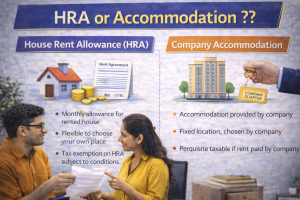
Are they treated the same?
Students (Samuel and all together): No Sir!
Correct. Let us understand why.
Case 1 – Employee Receives HRA
Facts:
Richard lives in Kolkata.
- Basic Salary = Rs.6,00,000 p.a.
- DA (forms part of salary) = Rs.1,20,000
- HRA received = Rs.2,40,000
- Rent paid = Rs.20,000 per month (Rs.2,40,000 yearly)
- City = Kolkata (Metro)
Step 1: Compute Salary for HRA
Salary = Basic + DA (forming part)
= 6,00,000 + 1,20,000
= Rs.7,20,000
Step 2: Exemption under Section 10(13A) read with Rule 2A
Least of the following:
1. Actual HRA received = Rs.2,40,000
2. Rent paid – 10% of salary
= 2,40,000 – 72,000
= Rs.1,68,000
3. 50% of salary (Metro city)
= 50% × 7,20,000
= Rs.3,60,000
Exemption = ₹1,68,000 (Least)
Taxable HRA = 2,40,000 – 1,68,000 = = Rs.72,000
Important Rule:
If employee:
- Does not pay rent
- Lives in own house
- Entire HRA becomes taxable.
Case 2 – Employer Provides Rent-Free Accommodation (RFA)
Now assume instead:
- No HRA paid
- Employer provides furnished accommodation in Kolkata
- Mohit works in a private company
- Basic + DA = Rs.7,20,000
- Furniture cost = Rs.3,00,000
Step 1: Value of Unfurnished Accommodation (Private Employee)
As per Rule 3:
If accommodation is owned by employer:
15% of salary (Metro city population > 25 lakh)
15% × 7,20,000 = Rs.1,08,000
Step 2: Add Furniture Value
10% per annum of furniture cost
10% × 3,00,000 = Rs.30,000
Total Perquisite Value:
= 1,08,000 + 30,000
= Rs.1,38,000
Entire Rs.1,38,000 is Taxable — (No exemption like HRA)
Comparison Table: HRA vs RFA
| Particular | HRA | Rent-Free Accommodation |
| Section | 10(13A) | Rule 3 |
| Nature | Allowance | Perquisite |
| Exemption Available? | Yes | No |
| Based on Rent Paid? | Yes | No |
| Calculation Complexity | Higher | Rule-based % |
| Fully taxable if no rent? | Yes | Always taxable |
Special Case: Government Employees
For Central/State Government employees:
RFA value = License fee determined by government (not 15%)
Very important difference.Conclusion: This discussion offers a synoptic view for conceptual clarity. For in-depth study and technical accuracy, students are advised to refer to the relevant sections of the Income Tax Act and prescribed rules.