

Accounting Standard AS 3 and its converged version Ind AS 7, which is aligned with IAS 7 under IFRS, are very important for students to understand the concept of cash flow. Cash flow is not the same as accounting profit. In many situations, the cash generated by a business may be higher or lower than the profit reported in the financial statements.
The cash flow statement explains how these differences arise and traces the actual movement of cash within the business. By classifying cash movements into operating, investing, and financing activities, it shows how cash is generated and how it is utilized during a particular period.
Through the following classroom discussion and practical examples, students will be able to clearly understand how positive or negative cash flows arise and how they relate to the financial performance of a company.
In a finance class, Professor writes on the smartboard: Cash Flow Statement – AS-3 / IFRS (IAS 7)
He turns to the students and says: Profit does not always mean cash. Investors, bankers, and analysts are more interested in where the cash actually comes from and where it goes.
He then draws three boxes on the board:
- Operating Activities
- Investing Activities
- Financing Activities
If a company sells products and receives cash from customers, where will that go?
Student Riya answers: Operating Activities
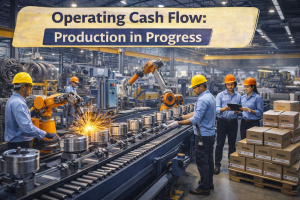
The professor nods and says: Operating activities represent cash generated from the main business operations. These indicate whether the business model itself is generating cash.
Suppose Toto Steel (imaginary) sells steel worth Rs. 500 crore.
Cash flows in operating activities may include:
Cash Inflows
| Cash received from customers |
| Royalty income |
| Commission income |
Cash Outflows
| Payment to suppliers (iron ore, coal) |
| Salary to employees |
| Power and fuel expenses |
| GST payments |
| Administrative expenses |
Professor: Interview insight
If a company shows high profit but negative operating cash flow, interviewers expect you to say: It may indicate aggressive revenue recognition, high receivables, or working capital issues.
Example:
Many startup companies show profits but face liquidity pressure because cash is stuck in receivables.
Investing Activities (Long-term asset decisions)

The professor now asks another question.
If a company buys new machinery for Rs.200 crore, where will it appear?
Student Ricky replies: Investing Activities.
Professor: Correct. Investing activities relate to purchase or sale of long-term assets and investments. They show how the company is investing for future growth.
Example: Automobile Company (Imaginary)
Suppose Murti Automobiles:
- Builds a new manufacturing plant in Gujarat
- Purchases robotic machinery
- Acquires shares in a joint venture
These are investing cash flows.
Typical Investing Activities
| Cash Outflows |
| Purchase of plant & machinery |
| Purchase of land or building |
| Acquisition of another company |
| Purchase of investments |
| Cash Inflows |
| Sale of machinery |
| Sale of investments |
| Interest received |
| Dividend received |
Professor: Interview tip
If a company has negative investing cash flow, it is often a good sign.
Why?
Because it may indicate expansion and future growth.
Example: (Imaginary)
Alliance Industries invests heavily in telecom infrastructure and retail networks.
Financing Activities (Capital structure decisions)
Professor asks the final question: f a company takes a bank loan of ₹500 crore, where will it appear?
Student Neha responds: Financing Activities.
Professor: correct, Financing activities relate to raising or repaying capital. They show how the company finances its operations and investments.
Example: Infrastructure Company (Imaginary)
Suppose Vadani Ports:
| Takes a loan from banks |
| Issues new shares |
| Pays dividends to shareholders |
These are financing activities.
Typical Financing Cash Flows
Cash Inflows
| Issue of shares |
| Issue of debentures |
| Bank loans raised |
Cash Outflows
| Repayment of loans |
| Redemption of debentures |
| Dividend paid |
| Interest paid |
Key Difference (Interview favourite question)
| Activity | Meaning | Example |
| Operating | Core business cash | Cash from selling goods |
| Investing | Long-term asset decisions | Buying machinery |
| Financing | Capital structure decisions | Taking loan |
Company Example
Let us consider a pharmaceutical company like Moon Pharma. (imaginary)
Operating Cash Flow
- Cash received from medicine sales
- Payments to chemical suppliers
- Employee salaries
Investing Cash Flow
- Purchase of research equipment
- Acquisition of a biotech startup
Financing Cash Flow
- Issue of bonds
- Dividend paid to shareholders

Interview question
- Sometimes interviewers ask: A company shows positive operating cash flow but negative free cash flow. Why?
Answer:
- Because the company may be investing heavily in capital expenditure (CAPEX) under investing activities.
Example: Amazon during its expansion phase
Takeaway:
Operate → Invest → Finance
- Operate – Cash from business
- Invest – Cash used for assets
Finance – Cash from investors and lenders
it helped me very much, thank you sir
pleased to know!
thank you sir
VERY HELPFUL
learned many topics in easy way. Thank you sir.
Sir, a small request, if it’s possible then please make a dedicated blog for interview purpose.
Each and every blog of Sujit Sir has detailed yet information that is easy to understand! Referring to these blogs always lets us have a clear picture about the topic.