

A letter of credit is essentially a financial document issued by a bank that guarantees payment to a seller on behalf of a buyer.
Normally, the bank’s customer is the importer, or the buyer of the goods. They work with the bank to issue the letter of credit to the exporter/seller.
The importer/buyer is the applicant of the LC, while the exporter/seller is the beneficiary. A guiding principle of an LC is that the issuing bank will make the payment based solely on the documents presented.
This discussion is based on international transactions
Rohit says to Amit: I want to import machinery from the USA worth $100,000, but the exporter is asking for payment security.

Amit replies: Why don’t you use a Letter of Credit (LC)? That way the bank guarantees payment. An LC for $100,000 can be opened in your favor by your banker.
Rohit goes to his bank.
Rohit: Sir, I want to open an LC for $100,000 in favor of John Inc., USA.
Mr. Sharma (Bank Manager):
Sure. We will issue a Letter of Credit on your behalf. But first, we need: documents….
- Import contract
- Proforma invoice
- Importer Exporter Code (IEC)
- Margin money (say 20%)
- Credit appraisal (if funded LC)
LC Application
Rohit fills LC application.
Suppose:
- LC Amount = Rs.100,000
- Margin = 20%
- Rohit deposits INR equivalent of 20%
Mr. Sharma says: We will now issue the LC through SWIFT message to our correspondent bank in the USA — Here comes the role of NOSTRO Account.
Indian Bank maintains a USD Nostro Account with a US bank.
The US bank will act as:
- Advising Bank (in USA)
US Bank informs John Inc.: an LC for $100,000 has been opened in your favor by Indian Bank.
Now John feels secure because: payment is guaranteed by Indian Bank.
John ships the goods to Rohit.
He submits documents to US Bank:
- Bill of Lading
- Commercial Invoice
- Insurance
- Packing List
- Bill of Exchange
US Bank verifies documents and sends them to Indian Bank.
Now Mr. Sharma receives documents.
If documents are in order: Indian Bank Debits Rohit.
Banking transactions hint:
Indian Bank will:
- Debit its USD Nostro Account
- Transfer Rs.100,000 to US Bank
- US Bank credits John’s account
Payment happens through Nostro account balance maintained in USA.
Amit asks:
Sir, how exactly does money move?
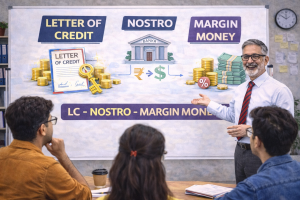
Mr. Sharma explains:
- We maintain USD in our Nostro Account in USA.
- When payment is due:
- We instruct US bank to debit our Nostro.
- US bank credits exporter.
- We recover INR from Rohit.
Complete Flow Summary
| Importer requests LC |
| Indian Bank issues LC |
| US Bank advises exporter |
| Exporter ships goods |
| Documents submitted |
| Indian Bank verifies |
| Payment made through Nostro |
| Importer receives goods |
Simple numerical illustration
| LC Amount = Rs.100,000 Spot Rate = Rs.80 |
| Total INR Liability = Rs.80,00,000 |
| If margin = 20% Rohit deposits = Rs.16,00,000 |
| Remaining = Bank finances Rs.64,00,000 |
| Bank pays $100,000 from Nostro account. |
| Journal entries: in the Books of Importer (Rohit) |
| Rohit deposits Rs.16,00,000 as margin. |
| Margin Money (LC) A/c Dr 16,00,000 To Bank A/c 16,00,000 |
| Note: Margin is shown as an asset until adjusted. |
| When Goods are Received |
| Goods purchased = Rs.80,00,000 |
| Purchases A/c Dr 80,00,000 To Bank (LC Liability) A/c 80,00,000 |
| Bank Adjusts Margin |
| Bank (LC Liability) A/c Dr 16,00,000 To Margin Money A/c 16,00,000 |
| Importer Pays Remaining Amount to Bank |
| Bank (LC Liability) A/c Dr 64,00,000 To Bank A/c 64,00,000 |
Learning Points from the Discussion with Mr. Sharma (Bank Manager)
| 1 | A Sight LC is a type of Letter of Credit under which payment is made immediately (at sight) to the exporter once the required documents are presented and found to be in order. |
| 2 | A Usance LC (also called a Deferred Payment LC) is a type of Letter of Credit under which the exporter receives payment after a specified credit period, not immediately. |
| 3 | LC is a Bank’s Conditional Guarantee The bank does not guarantee goods. It guarantees payment against compliant documents. Payment obligation arises only if documents are in order. |
| 4 | LC is Initially a Non-Fund Based Facility When LC is issued: No immediate cash outflow It is a contingent liability for the bank When documents are accepted and payment is made: It becomes a fund-based liability |
| 5 | Nostro Account Plays a Central Role International payments under LC are settled through: Bank’s Nostro Account Maintained in foreign currency with correspondent bank Thus, LC directly affects: Foreign currency liquidity Exchange position Treasury management |
| 6 | LC is Part of Working Capital Finance The discussion clearly shows that: LC is not an isolated instrument. It forms part of the overall working capital limit sanctioned to the importer. Banks generally sanction: Fund-based limits (Cash Credit, OD) Non-fund based limits (LC, Bank Guarantee) LC operates within this sanctioned limit and supports the trade cycle. |
| 7 | Margin Requirement is Essential The bank requires a certain percentage of margin (say 10–30%) from the importer. Thus, working capital support is not 100% bank-funded — The client must contribute part of the funds. |
From the above discussion, we understand that a Letter of Credit is not merely a payment instrument but a structured banking arrangement embedded within the working capital finance framework.