
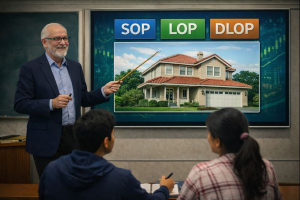
Before we delve into the computations, let us first understand the various types of house properties and how the income from each is brought to tax under the head ‘Income from House Property’.
Income tax classifies the properties in three ways:
Self-Occupied House Property
Let Out House Property
Deemed to be Let Out Property
Self-Occupied House Property (SOP):
A house property which is used by the owner for his/her own residence.
- Annual Value: Taken as Nil
- Deduction for interest on housing loan: Allowed up to Rs.2,00,000 (subject to conditions)
Example:

Nondita lives in her own house in Kolkata.
Let-Out House Property (LOP):
A house property which is actually rented out during the year.
- Annual Value: Based on actual rent / expected rent
- Deductions:
- Standard deduction @ 30%
- Interest on borrowed capital (no upper limit)
Example:
Disha has given her flat on rent and earns monthly rent.
Deemed to be Let-Out Property (DLOP)
When an individual owns more than two houses for self-occupation, only two can be treated as self-occupied.
The other house(s) are deemed to be let out, even if not actually rented.
- Annual Value: Calculated on notional rent
- Deductions:
- Standard deduction @ 30%
- Interest on borrowed capital (no limit)
Example:
Mohit owns three houses. He lives in two and keeps the other vacant.
The vacant house is treated as Deemed Let-Out Property.
A Small Discussion in the Professor’s Room
After the class, Nondita, Disha and Mohit walked into the professor’s room with their notebooks open. They had been discussing among themselves while revising Income from House Property.
Nondita:
We understood self-occupied and let-out house property in class. But what if the same house is partly self-occupied and partly let out at the same time?
Disha:
Yes, like living on one floor and giving another floor on rent. How do we calculate annual value then?
Mohit (thinking clearly):
And what if we stay in the house for some months and rent it out for the remaining months in the same year? Does the calculation change?
At this point, the professor smiled and explained calmly.
Professor:
If a house is partly self-occupied and partly let out at the same time, the law treats it as two separate house properties.
The self-occupied portion will have Nil annual value, and the let-out portion will be taxed based on rent.
Expenses like municipal taxes and interest are apportioned.
Professor (continuing):
But if the house is self-occupied for part of the year and let out for another part, then there is no time-wise division.
Even if it is let out for a short period, the house is treated as let-out for the entire year.
The three students exchanged looks and nodded.
Disha:
So area-wise split is allowed, but time-wise split is not?
Professor:
Exactly. That one sentence will help you answer many exam and interview questions.
The students smiled, thanked the professor.
Nondita:
Sir… I think I understand the concept now, but could you please show us two numerical illustrations? That would really help us feel confident.
The professor smiled reassuringly.
Professor:
Of course, Nondita. Let me show you two simple numerical illustrations, one for area-wise division and another for time-wise usage.

Disha owns a house with two floors:
- Ground floor: Self-occupied
- First floor: Let out at Rs.12,000 per month
- Municipal taxes paid: Rs.24,000
- Interest on housing loan: Rs.1,80,000
Solution:
The house is treated as two separate properties.
Let-out portion:
- Gross Annual Value (Rs.12,000 × 12) = Rs.1,44,000
- Municipal tax (50%) = Rs.12,000
- Net Annual Value = Rs.1,32,000
- Standard deduction @30% = Rs.39,600
- Interest (50%) = Rs.90,000
- Income from LOP = Rs. 2400
Self-occupied portion:
- Annual Value = Nil
- Interest deduction = Rs.90,000 (within limit)
- Income from SOP =Rs. (90,000)
Disha’s income from House Property = Rs. 2,400 + (Rs. 90,000) = Rs. (87,600).

Mohit owns a house
- Self-occupied: April to September
- Let out: October to March @ Rs.15,000 per month
- Municipal taxes paid: Rs.18,000
- Interest on housing loan: Rs.2,40,000
- Municipal value: Rs. 1,40,000
Solution:
The house is treated as let-out for the entire year.
- Actual Rent (Rs.15,000 × 6) = Rs.90,000
- Municipal value = Rs. 1,40,000
- Gross Annual Value (GAV) = higher of the two
- GAV =Rs. 1,40,000
- Municipal taxes = Rs.18,000
- NAV = Rs.1,22,000
- Standard deduction @30% on NAV = Rs. 36,600
- Interest on borrowed capital = Rs.2,40,000 (Full interest deduction allowed)
- Income from House Property (Rs. 1,54,000)
All three students discussed the concept smilingly. Before leaving, they thanked the professor and said that it was really interesting to understand how a property fetches income. The professor, sipping his tea, smiled back at them.
Takeaway
| A house property may be self-occupied, let out, or deemed to be let out |
| If a house is partly self-occupied and partly let out (area-wise), it is treated as two separate house properties |
| If a house is self-occupied for part of the year and let out for another part, it is treated as let-out for the entire year |
| Area-wise split is allowed; time-wise split is not allowed |
| Annual Value is based on expected rent if it is higher than actual rent |
| Proper understanding of Annual Value is crucial to compute taxable income from house property |