
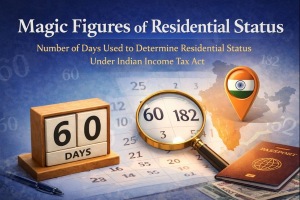
The magic figures of the number of days used to determine residential status under the Indian Income Tax Act are extremely important. The sum and applicability of tax on a person, depends upon the Residential Status of such person. Residential status of a person is important in determining the scope of income on which income tax has to be paid in India.
Residential status today is based not only on days, but also on income connection with India.
After the class, two students Deepika and Sayantan entered the professor’s room with their workbooks, eager to clarify their doubts on residential status
Scene: Teacher’s room after class
Deepika
Sir, we know the basic conditions relating to the “magic figures” in residential status:
Residential Status – Section 6
Basic & Additional Conditions (Magic Figures)
| Type of Condition | Figures / Criteria | What it Indicates |
| Basic Condition – I | 182 days in India during the relevant previous year | Direct test for Resident |
| Basic Condition – II | 60 days in current year + 365 days in preceding 4 previous years | Alternate test for Resident |
| Additional Condition – I | Resident in at least 2 out of 10 preceding previous years | Determines Ordinary Residence |
| Additional Condition – II | Stay of more than 729 days in preceding 7 previous years | Determines Ordinary Residence |
Deepika:
But I want to ask a question about the 120 days rule and the Rs.15 lakh income condition. How does this fit into Section 6? I’m confused.
Professor(smiling)
That confusion is very natural.
Deepika, Sit down—this change is important.
Sayantan:
Sir, as far as I know, Section 6 states 182 days decides residential status.
Professor:
– that’s correct, but there is a new provision added also.
Assume someone earning Rs.30 lakh from India, but staying only 130 days and claiming
I’m a Non-Resident. My foreign income is safe.
Now listen carefully—this applies only to Indian citizens or Persons of Indian Origin.
Deepika:
Then the person becomes Resident?
Professor:
He becomes Resident but Not Ordinarily Resident (RNOR).
Sayantan:
Sir, what about people who live nowhere for tax purposes?
Professor:
Excellent question.
Under Section 6(1A):
- If an Indian citizen
- Earns more than Rs.15 lakh in India
- And is not liable to tax in any country
Then even if he stays in India for a very short period.
Deepika:
He is still considered Resident?
Professor
Yes—Deemed Resident, but again as RNOR only.
Deemed resident does not mean global taxation.
Professor writes:
- 182 days — Resident
- 120–181 days + Indian income exceeding Rs.15 lakh — RNOR
- No tax residence anywhere + income exceeding Rs.15 lakh — Deemed Resident (RNOR)
Sayantan:
Sir, so now residential status depends on:
- Days of stay
- Income level
- Tax liability abroad
Professor:
Let’s look at four simple cases—this will make everything clear
Case 1:
Mr. Sourav, an Indian citizen:
- Stay in India in FY 2024–25: 200 days
- Resident in all of the last 10 years
- Stay in India in last 7 years: 900 days
Application:
- Resident under 182-day rule – satisfied
- Not non-resident in 10 preceding years – satisfied
- Stay > 740 days – satisfied

Residential Status: Resident & Ordinarily Resident (ROR)
Case 2:
Mr. Rahul, an Indian citizen:
- Stay in India in FY 2024–25: 190 days
- Non-Resident in the last 9 years
- Stay in India in last 7 years: 750 days
Application:
- Resident under 182-day rule – satisfied
- Not resident in 2/10 preceding years – not satisfied
- Stay > 750 days – satisfied
Residential Status: Resident but Not Ordinarily Resident (RNOR)– (fails additional conditions)
Case 3:
Mr. Kartik, an Indian citizen:
- Stay in India in FY 2024–25: 45 days
- Non-Resident in the last 3 years
- Stay in India in last 7 years: 750 days
Application:
- Resident under 182-day rule – not satisfied
- Not resident in 3/10 preceding years – NA
- Stay > 750 days – NA

Non-Resident (NR)
Deemed Resident (DR – Section 6(1A))
Case:4
Ms. Romi, an Indian citizen:
- Income in India: Rs 25 lakh
- Stay in India: 30 days
- Not liable to tax in any other country
- Non-resident in most earlier years
Application:
- Deemed resident under Section 6(1A)
- As per law — always RNOR
Residential Status: Deemed Resident (RNOR)

Deepika and Sayantan looked relieved and jovial after this explanation. As they were leaving the room, both students thanked the professor. The professor nodded with a warm smile, watching them go.