
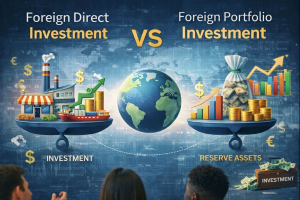
International Business (IB) refers to the exchange of goods, services, capital across national borders and technology. It involves the operations of MNCs, exports, imports, FDI and FPI.
Each form creates different financial responsibilities:
- Exports — deal with exchange rates, payment risks
- Licensing — handle royalty payments in foreign currency
- JVs — require cross-border capital flows and shared risk
- Subsidiaries — require long-term FDI and profit repatriation
- Collaborations — involve international contracts and shared costs
- Management contracts — involve global service
- Affiliates — deal with transfer pricing and multi-currency accounting
International business activities do not remain confined to corporate balance sheets; they directly affect a country’s foreign exchange inflows and outflows, and hence its Balance of Payments (BOP). The Balance of Payments (BOP) is a statement that summarizes all economic transactions between residents of a country and the rest of the world.
The impact of major forms of international business on India’s BOP is explained below.
Exports – Exchange Rates & Payment Risk
BOP Impact: Current Account – Goods (Credit)
Example:
An Indian pharmaceutical company exports medicines to the US worth USD 5 million.
- Foreign currency inflow increases India’s export earnings.
- If the rupee depreciates, export receipts rise in rupee terms.
Impact: Improves current account but exposed to exchange rate and credit risk.
Licensing – Royalty Payments
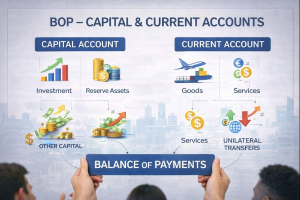
BOP Impact:
- Royalty received: Current Account – Services (Credit)
- Royalty paid: Current Account –(Debit)
Example:
An Indian pharma company pays USD 2 million royalty to a US firm for drug patents.
- Regular foreign exchange outflow in the form of royalty.
- Affects India’s current account negatively.
Impact: Continuous forex outflow; sensitive to exchange rate movements.
Joint Ventures (JVs) – Capital Flows & Risk Sharing
BOP Impact: Financial Account –(FDI)
Example:
An Indian auto company forms a JV with a Garman firm, which invests USD2100 million.
- Capital inflow strengthens financial account.
- Technology and management expertise reduce long-term trade deficits.
Impact: Improves financial account and reduces dependence on external borrowing.
Subsidiaries – FDI & Profit Repatriation
BOP Impact:
- FDI inflow: Financial Account (Credit)
- Profit repatriation: Current Account – (Debit)
Example:
A Japanese MNC sets up a manufacturing subsidiary in India with USD 500 million FDI.
- Initial inflow improves BOP.
- Later, dividend payments and profit repatriation cause forex outflow.
Impact: Economic growth and employment opportunity.

Collaborations
BOP Impact:
Payments and receipts appear in Current Account – Services
Example:
An Indian engineering firm collaborates with a UK company for infrastructure design.
- Consultancy fees paid or received in foreign currency.
- Shared project costs lead to periodic forex flows.
Impact: Affects service account and requires exchange rate management.
Management Contracts – Service Receipts
BOP Impact: Current Account – Services (Credit)
Example:
An Indian hotel chain manages a hotel in the Middle East and earns USD 5 million annually.
- Foreign exchange inflow without capital investment.
- Improves current account and service exports.
Impact: Stable forex earnings with low capital risk.
Affiliates – Transfer Pricing & Multi-Currency Accounting
BOP Impact:
- Trade in goods/services affects Current Account
- Financial flows affect Financial Account
Example:
An Indian parent company sells components to its overseas affiliate.
- Transfer pricing affects export values.
- Multiple currencies complicate accounting and tax reporting.
Impact: Influences both trade balance and capital flows; regulatory oversight required.
Overall Conclusion Every form of international business activity—whether export, licensing, joint venture, or subsidiary—creates foreign exchange flows that enter India’s Balance of Payments. Understanding these linkages helps finance students understand how global corporate decisions influence a country’s economic stability, exchange rate movements, and reserve position.
Very Easily Explained sir , thanks a lot
Thank you so much sir it truly helped.